Film
Art: An Introduction
by David Bordwell and Kristin Thompson
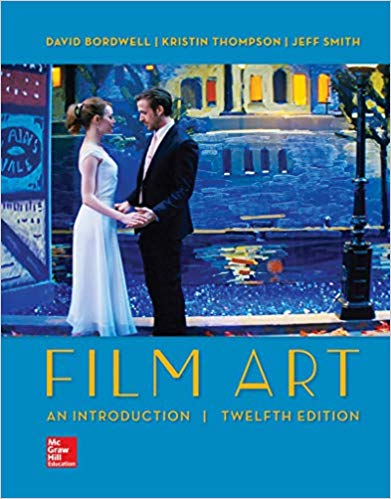
about the bookFilm
Art: An Introduction is a survey of film as an art form. It’s aimed
at undergraduate students and general readers who want a comprehensive and systematic
introduction to film aesthetics. It considers common types of films, principles
of narrative and non-narrative form, basic film techniques, and strategies of
writing about films. It also puts film art in the context of changes across history. Film
Art first appeared in 1979 and is currently in its eleventh edition, published
by McGraw-Hill. For more on our purposes in writing it, go
here on this site.
Film analyses from earlier editions of Film
Art
As Film Art went through various editions, we
developed analyses of various films that might be used in an introductory course.
But as space grew tight or certain films dropped out of circulation, we cut those
analyses and replaced them with others. The Internet allows us to revive these
old pieces. Many of the films are now available on DVD, and we invite students
and professors to use these analyses in examining the movies.
The essays here are taken from the edition featuring their
last revision.
10th edition
Functions of Film Sound: The Prestige
dir. Christopher Nolan, 2006. From Film Art,
10th edition, McGraw-Hill (2012): 298–306.
In London around 1900, two magicians are locked in desperate competition, each searching for ever more baffling illusions. As they deceive each other and their audiences, the film about them tries to deceive us as well.
A story of crime, professional rivalry, personal jealousy, and grand aspirations, The Prestige sets itself a difficult task. The film tries to be as tantalizing as a magic trick, but one that can eventually be explained. As a result, director Christopher Nolan and his screenwriter (and brother) Jonathan Nolan must both reveal and conceal information. The film must present us just enough of the story to keep us engaged, while holding back the answers to the puzzles—and sometimes, like a magician, distracting us from what is really going on. Throughout The Prestige, sound is crucial to an elaborate choreography of misdirection.
Read this essay
9th edition
An Example of Associational Form: A Movie
dir. Bruce Conner, 1958. From Film Art,
9th edition, McGraw-Hill (2010): 376–381.
Bruce Conner’s film A Movie illustrates how associational form can confront us with evocative and mysterious juxtapositions, yet can at the same time create a coherent film that has an intense impact on the viewer.
Conner made A Movie, his first film, in 1958. Like Léger, he worked in the visual and plastic arts and was noted for his assemblage pieces—collages built up of miscellaneous found objects. Conner took a comparable approach to filmmaking. He typically used footage from old newsreels, Hollywood movies, soft-core pornography, and the like. By working in the found-footage genre, Conner juxtaposed two shots from widely different sources. When we see the two shots together, we strive to find some connection between them. From a series of juxtapositions, our activity can create an overall emotion or concept.
Read this essay
An Example of Experimental Animation: Fuji
dir. Robert Breer, 1974. From Film Art,
9th edition, McGraw-Hill (2010): 388–390.
In contrast to smooth Hollywood narrative animation, Robert Breer’s 1974 film Fuji looks disjointed and crudely drawn. It doesn’t involve a narrative but instead, like Ballet mécanique, develops according to principles of abstract form.
Fuji begins without a title or credits, as a bell rings three times over blackness. A cut leads not to animated footage but to a shaky, fuzzy shot through a train window, with someone’s face and eyeglasses partially visible at the side in the extreme foreground. In the distance, what might be rice paddies slide by. This shot and most of the rest of the film are accompanied by the clacking, rhythmic sound of a train. More black leader creates a transition to a very different image. Against a white background, two flat shapes, like keystones with rounded corners, alternate frame by frame, one red, the other green. The effect is a rapid flicker as the two colored shapes drift about the frame in a seemingly random pattern. Another stretch of black introduces a brief, fuzzy shot of a man in a dark suit running across the shot in a strange corridor.
Read this essay
8th edition
A
Man Escaped
dir. Robert Bresson, 1956. From Film Art,
8th edition, McGraw-Hill (2006): 293–300.
Robert Bresson’s A Man Escaped (Un
Condamné à mort
c’est échappé) illustrates how a variety of sound techniques
can function throughout an entire film. The story takes place in France in 1943.
Fontaine, a Resistance fighter arrested by the Germans, has been put in prison
and condemned to die. But while awaiting his execution, he works at an escape
plan, loosening the boards of his cell door and making ropes. Just as he is ready
to put his plan in action, a boy named Jost is put into his cell. Deciding to
trust that Jost is not a spy, Fontaine reveals his plan to him, and they are
both able to escape.
Throughout the film, sound has many important functions.
As in all of his films, Bresson emphasizes the sound track, rightly believing
that sound may be just as cinematic as images. At certain points in A
Man Escaped, Bresson
even lets his sound technique dominate the image; throughout the film, we are
compelled to listen. Indeed, Bresson is one of a handful of directors who create
a complete interplay between sound and image.
 Download this essay Download this essay
5th edition
High School
dir. Frederick Wiseman, 1968. From Film Art, 5th edition, McGraw-Hill (1996): 409–415.
Frederick Wiseman’s High School is a good example of the cinéma-vérité approach. Wiseman received permission to film at Philadelphia’s Northeast High School, and he acted as sound recordist while his cameraman shot footage in the hallways, classrooms, cafeteria, and auditorium of the institution. The film that resulted uses no voice-over narration and almost no nondiegetic music. Wiseman uses none of the facing-the-reporter interviews that television news coverage employs. In these ways, High School might seem to approach the cinéma-vérité ideal of simply presenting a slice of life. Yet if we analyze the film’s form and style, we find that it still aims to achieve particular effects on the spectator, and it still suggests a specific range of meaning. Far from being a neutral transmission of reality, High School shows how film form and style, even in cinéma-vérité, shape the event we see on film.
Download this essay
4th edition
Stagecoach
dir. John Ford, 1939. From Film Art, 4th edition, McGraw-Hill (1992): 366–370.
Film theorist André Bazin has written of John Ford’s Stagecoach: “Stagecoach is the ideal example of the maturity of a style brought to classic perfection…Stagecoach is like a wheel, so perfectly made that it remains in equilibrium on its axis in any position.” This effect results from the film’s concentration on the creation of a tight narrative unity, with all of its elements serving that goal.
Download this essay
Hannah and Her Sisters
dir. Woody Allen, 1985. From Film Art, 4th edition, McGraw-Hill (1992): 376–381.
It’s a typical approach that one person or a couple function as the protagonists of a film. Yet many Hollywood films use multiple protagonists. Woody Allen’s Hannah and Her Sisters examines the psychological traits and interactions among a group of characters. We shall see that creating several protagonists does not necessarily make a film any less “classical” in its form and style.
Download this essay
Desperately Seeking Susan
dir. Susan Seidelman, 1985. From Film Art, 4th edition, McGraw-Hill (1992): 381–387.
In many classical films, groups of characters interact to create causes and motivations. Their actions, added together, steadily push the action forward. In Desperately Seeking Susan, however, the two protagonists, the staid New Jersey housewife Roberta and the wild, streetwise Susan, initially seem to have little connection to each other. The early portion of the plot alternates sequences involving the two women, but, although Roberta reads about Susan in the personals column and becomes fascinated with her, they do not interact directly. Yet the two women’s lives gradually begin to intertwine, until they finally meet at the end. The form of the film depends on devices of parallelism that point up how the women are actually somewhat alike.
Download this essay
Day of Wrath
dir. Carl Dreyer, 1943. From Film Art, 4th edition, McGraw-Hill (1992): 387–391.
Many films pose few difficulties for viewers who like their movies straightforward and easy to digest. But not all films are so clear in their form and style. In films like Day of Wrath, the questions we ask often do not get definite answers; endings do not tie everything up; film technique does not always function invisibily to advance the narrative. When analyzing such films, we should restrain ourselves from trying to answer all of the film’s questions and to create neatly satisfying endings. Instead of ignoring peculiarities of technique, we should seek to examine how film form and style create uncertainty — seek to understand the cinematic conditions that produce ambiguity. Day of Wrath, a tale of witchcraft and murder set in seventeenth-century Denmark, offers a good test case.
Download this essay
Last Year at Marienbad
dir. Alain Resnais, 1961. From Film Art, 4th edition, McGraw-Hill (1992): 391–396.
When Last Year at Marienbad was first shown in 1961, many critics offered widely varying interpretations of it. When faced with most films, these critics would have been looking for implicit meanings behind the plot. But, faced with Marienbad, their interpretations were attempts simply to describe the events that take place in the film’s story. These proved difficult to agree on. Did the couple really meet last year? If not, what really happened? Is the film a character’s dream or hallucination?
Download this essay
Innocence Unprotected
dir. Dušan Makavejev, 1968. From Film Art, 4th edition, McGraw-Hill (1992): 401–406.
Like Last Year at Marienbad, Dušan Makavejev’s Innocence Unprotected (more correctly translated as Innocent Unprotected) diverges markedly from the norms of classical narrative filmmaking. In analyzing the film, it is useful to think of its form as a collage, an assemblage of materials taken from widely different sources. By playing up the disparities among the film’s materials, the collage principle permits Makavejev to use film techniques and film form in fresh and provocative ways. The result is a film that examines the nature of cinema — particularly, cinema in a social and historical context.
Download this essay
Clock Cleaners
dir. Walt Disney, 1937. From Film Art, 4th edition, McGraw-Hill (1992): 418–420.
Clock Cleaners is a narrative, but it does not adhere to the typical patterns of narrative development that are frequently at work in feature-length Hollywood films. Employing a strategy common in slapstick shorts, it sets up a situation and then has the characters perform a series of nearly self-contained skits or gags, building up as the film goes along. In this case, three familiar stars, Mickey Mouse, Goofy and Donald Duck, all appear, each working in a different part of the huge clock tower. They do not interact until near the end of the film. No overall pattern like a search or a journey helps the plot develop; although the characters could be said to share a general goal of cleaning the clock, they have not accomplished it by the end of the film, and our sense of narrative progression has more to do with their mishaps than with any work they may get done.
Download this essay
Tout va bien
dir. Jean-Luc Godard, 1972. From Film Art, 4th edition, McGraw-Hill (1992): 436–442.
If Meet Me in St. Louis uncritically affirms the value of family life and Raging Bull offers an ambivalent critique of violence in American society, Tout va bien strongly attacks certain features of the state of French society in 1972. We shall use it as an example of how a film may present an ideological viewpoint explicitly and drastically opposed to that of most viewers.
Download this essay
2nd edition
The Man Who Knew Too Much
dir. Alfred Hitchcock, 1934. From Film Art, 2nd edition, McGraw-Hill (1988): 292–295.
Like His Girl Friday, The Man Who Knew Too Much presents us with a model of narrative construction. Its plot composition and its motivations for action contribute to making the film what a scriptwriter would call “tight.” Moreover, the film also offers an object lesson in the use of cinematic style for narrative purposes. Finally, the film illustrates how narration can manipulate the audience’s knowledge, sometimes making drastic shifts from moment to moment.
Download this essay
| | |
|
|
|
| |
|